
Why Your Microbiology Notes Are Failing You
Three weeks into my first microbiology course, I was convinced I had picked the wrong major. Every lecture felt like learning a foreign language, and staring at a textbook full of Latin names only made my anxiety worse. I was not alone. Today, class averages in prerequisite microbiology courses frequently hover in the 60% to 70% range, and it remains one of the primary bottleneck courses for nursing and pre-med students nationwide.
If you are reading this, you are probably dealing with the exact same terminology overload. A common hurdle I hear from students in my office hours is that the sheer volume of unfamiliar words, such as names of bacteria, spores, and specific characteristics, feels entirely overwhelming without a strong foundation. You are trying to memorize the Krebs Cycle, enzyme reaction rates, and taxonomy, but your notes are just a chaotic mess of highlighted text. A student on a popular college Reddit forum perfectly captured this feeling recently, complaining that the course requires heavy memorization of pathways and cycles rather than genuine conceptual understanding.
But here is the reality: trying to rote-memorize your microbiology textbook is a fast track to burnout. In this guide, I will show you the exact 4-step note-taking system that helps pre-med and nursing students master complex pathways and taxonomy without pulling all-nighters.
After 12 years of teaching introductory microbiology, I have watched thousands of students fail and succeed. The ones who succeed do not just study harder. They take a fundamentally different approach to organizing information, knowing that how you write down the data dictates how well your brain can retrieve it under pressure.
What Actually Makes a Good Microbe Note?
At their core, effective microbe notes are highly structured visual frameworks that categorize microorganisms by their clinical behavior and biochemical pathways, rather than just transcribing a professor's lecture verbatim. They act as a translation layer between dense academic research and practical, testable knowledge.
Most textbooks stop at the biological taxonomy. They group bacteria by genus and species, and leave you to memorize the list. But frankly, most textbooks get this wrong for students entering healthcare. The nuance is that you do not need to be a taxonomist. You need to be a clinician. When you see a patient with a respiratory infection, you are not going to pull out a textbook index. You need to know which microbes target which systems. If your notes do not reflect that clinical reality, you are making the class twice as hard as it needs to be.
I will be honest, I struggled with this concept too when I was an undergraduate. I spent hours making flashcards for every single bacterium in alphabetical order. It was a complete waste of time. I had the facts, but I lacked the context. There is genuine debate about this in the educational field, but I firmly believe that clinical context is far more valuable than raw data.
Take the Krebs Cycle, for example. I see students try to memorize every single intermediate molecule in a linear list. But that completely misses the point. The cycle is not a list; it is a biochemical engine. If you understand what the engine is trying to achieve, like producing energy carriers such as NADH, the individual steps make logical sense. If your notes do not capture that overarching goal, you are just memorizing random chemical names.
To take notes that actually work, you need to understand the etymology. Microbiology is built on Latin and Greek roots. "Staphylo" means cluster, and "coccus" means berry or sphere. "Aureus" means golden. When you know the roots, Staphylococcus aureus is not a random string of letters. It is a golden cluster of spherical bacteria. Once you decode the language, the pathways stop looking like a foreign language and start looking like a descriptive map.

The difference between a failing student's notes and a top student's notes is not the volume of ink on the page. It is the structure. A student who categorizes an organism by its Gram stain, morphology, and clinical presentation is actively synthesizing the material.
The Evolution of Microbiology Study Methods
To understand why we struggle so much with microbiology notes today, we have to look at how the subject used to be taught.
Historically, studying microbiology was an exercise in brute-force memorization. Before the digital age, students relied on dense manuals and massive physical textbooks. For decades, the pedagogy was entirely passive. The professor lectured, you wrote it down, and you memorized it. You were expected to stare at text until it stuck in your brain.
But the field of STEM education has evolved significantly over the last decade. A landmark 2014 study published in the journal CBE Life Sciences Education by Freeman et al. proved that active learning course designs could decrease failure rates by up to 55% compared to traditional lecturing. The data became impossible to ignore. Education experts realized that passive transcription was failing students, particularly in highly visual and complex sciences like microbiology.
This realization sparked a massive shift in how students approach the material. The mid-2010s saw the rise of visual mnemonic tools like SketchyMicro, which transformed how medical students retained complex pathways. The focus moved from reading the text to drawing the diagram. Students began to realize that if they could visualize a concept, they could bypass hours of tedious rote memorization.
Consider the difference between reading about a Widal test versus physically drawing the antigen-antibody agglutination process. In one scenario, you are hoping the text sticks in your short-term memory. In the other, you are actively engaging your spatial and motor memory. Educational research from the National Institutes of Health confirms that interactive technologies and formative self-assessments improve engagement and exam scores across the board.
Today, the current state of microbiology education is in a transitional phase. According to recent 2024 institutional data from major university systems published at various .edu domains, courses that implement active, structured learning boast success rates around 76%. Meanwhile, traditional lecture formats continue to see much higher attrition. Yet, despite this evidence, many professors still teach using the old, passive methods. They stand at the front of a lecture hall of 200 students and read off PowerPoint slides.
Why do you need to know this history? Because if your professor is still teaching like it is 1995, you cannot study like it is 1995. You have to take control of your own notes. You must force active learning onto a passive lecture. If you rely solely on what is handed to you, you will likely fall into that 24% failure bracket. Your notes must be active tools of engagement, not passive records of what was said.
The 4-Step System for Microbe Notes
If there is one concept that separates students who merely pass from those who truly master microbiology, it is clinical contextualization. Most students try to memorize bacteria alphabetically or by taxonomic class, simply because that is how the textbook presents the material. I will be honest, I tried this exact method first during my undergraduate years, and it was a complete disaster. I could recite the names, but I could not answer a single application question on the exam. Here is the 4-step framework I teach my students to use instead, designed specifically to build clinical reasoning rather than robotic repetition.
Step 1: Establish the Clinical Context
Identify the patient presentation before writing down any biological characteristics.
In a clinical setting, you do not start your diagnosis with a Gram stain result; you start with a patient's symptoms. A 2024 educational review from Washington University in St. Louis (wustl.edu) found that nursing and pre-med students who used case-based learning retained 40% more diagnostic criteria than those relying on standard textbooks. By anchoring the biological facts to a human experience, your brain has a much easier time retrieving the information.
Quick Tip: Write the primary disease name in red ink at the top of your notebook page before writing the organism's name. Let the disease drive the data.
Step 2: Group by Body System
Organize your notebook by respiratory, gastrointestinal, genitourinary, and systemic infections.
When you take your board exams (like the NCLEX or USMLE), the questions are categorized by body systems and patient complaints, not by whether the bacteria are Gram-positive or Gram-negative. If you learn the pathogens in the context of the organ systems they attack, you are already studying for your boards. This method forces you to compare and contrast organisms that cause similar symptoms, which is exactly how exam questions are designed to trick you.
Quick Tip: Create a master table of contents in your notebook that lists every organism by the primary organ system it infects, serving as a quick-reference differential diagnosis sheet.
Step 3: Visualize the Pathogenesis
Draw a simple flowchart showing how the organism enters the body, evades the immune system, and causes tissue damage.
Pathogenesis is a dynamic process, not a static list of facts. Take the classic 2024 case study of Mycoplasma pneumoniae published in the Infectious Diseases and Clinical Microbiology (IDCM) journal. The students who successfully identified the atypical pneumonia in the case study did not just memorize the phrase "walking pneumonia." They physically mapped out the pathogenesis, visualizing how the bacteria lacks a rigid cell wall, which immediately explains why prescribing beta-lactam antibiotics (which target cell walls) is completely useless. A visual map connects the biological structure directly to the pharmacological treatment.
Quick Tip: Use arrows, boxes, and simple stick figures. You are not being graded on your art skills; you are building spatial memory.
Step 4: Active Recall and Spaced Repetition
Convert your structured notes into flashcards or self-quizzing prompts within 24 hours of the lecture.
Taking the notes is only the first half of the battle. You have to actively retrieve the information to make it permanent. A comprehensive 2023 survey reported that over 70% of successful medical and nursing students heavily rely on spaced repetition software like Anki to retain the sheer volume of microbiology facts. The system only works if you test yourself repeatedly over increasing intervals.
Quick Tip: Frame your flashcards as clinical scenarios (e.g., "A 25-year-old patient presents with a stiff neck and photophobia...") rather than direct, contextless definitions.
Common Pitfalls in Microbiology Notes
I have graded thousands of microbiology exams over the past decade, and the mistakes that cost students a passing grade are almost always identical. The issue is rarely a lack of intelligence or effort. Instead, it is a fundamental lack of integration between the laboratory exercises and the lecture material.
Students frequently treat the lecture and the lab as two entirely different courses that happen to share the same name. They take meticulous lecture notes on microbial genetics on Monday, and on Wednesday, they perform a biochemical lab test without ever connecting the two concepts. They fail to realize that the laboratory data is simply the physical manifestation of the lecture theory.
According to the 2023 Louisiana State University Health Sciences Center (lsuhsc.edu) laboratory manual data, students who actively cross-reference their lecture notes with their lab results score consistently a full letter grade higher on their final practical exams. The disconnect happens because students write down the "what" (the lab result) without annotating the "why" (the lecture concept).
Let us look at a real-world clinical scenario involving Staphylococcus epidermidis to see how this plays out. Imagine a patient in the ICU has a blood culture drawn that comes back positive for this specific organism. A student who only memorized the lecture textbook might immediately panic, assuming the patient has a severe, life-threatening bacteremia. However, a student who integrated their lab notes and understands standard clinical procedures knows that S. epidermidis is normal human skin flora. It is a highly frequent contaminant of poorly drawn blood cultures. Therefore, the integrated student would wait for a second blood culture confirmation before prescribing heavy IV antibiotics. Same exact data point, but a radically different clinical decision based entirely on how the notes were structured.
If your notes do not bridge the gap between the theoretical textbook and the physical agar plate, you are studying with one eye closed.
Rote Memorization vs. System-Based Learning
When students struggle with the sheer volume of microbiology, their default reaction is usually to double down on rote memorization. They make hundreds of extra flashcards and spend hours staring at them, hoping the sheer repetition will force the knowledge into their brains. But we need to critically compare this brute-force method with system-based learning, specifically concept mapping, to understand why working harder is not always working smarter.
Framework 1: Rote Memorization (Active Recall)
This framework involves drilling isolated facts into
your short-term memory through repetitive testing. It is
undeniably excellent for recalling specific, discrete
terminology. For instance, knowing instantly that
Escherichia coli is a Gram-negative rod or that
Bacillus anthracis forms endospores. However, it
completely fails when you need to synthesize information
across different chapters or apply those facts to a complex
patient presentation.
Framework 2: System-Based Concept Mapping
This framework involves creating a visual
representation of how different pathogens, immune responses,
and pharmacological treatments relate to one another within a
specific environment. Extensive research from the National
Institutes of Health (nih.gov) highlights that concept mapping significantly enhances
critical thinking. It forces students to build hierarchical
structures of knowledge, moving beyond simple definitions to
understand the "how" and "why" of infectious diseases.
| Aspect | Rote Memorization (Active Recall) | System-Based Concept Mapping |
|---|---|---|
| Key Focus | Isolated facts, discrete definitions, and terminology. | Relationships, clinical pathways, and "big picture" understanding. |
| Best For | Quick, rapid-fire recall of specific biological characteristics. | Understanding complex pathogenesis and differential diagnoses. |
| Limitations | Poor for synthesizing complex scenarios; creates a fragile knowledge base. | Can be very time-consuming to create initially; requires strong foundational knowledge. |
| Example Application | Memorizing Gram stain results and simple morphological shapes. | Mapping the cascade of the human immune response to a viral infection. |
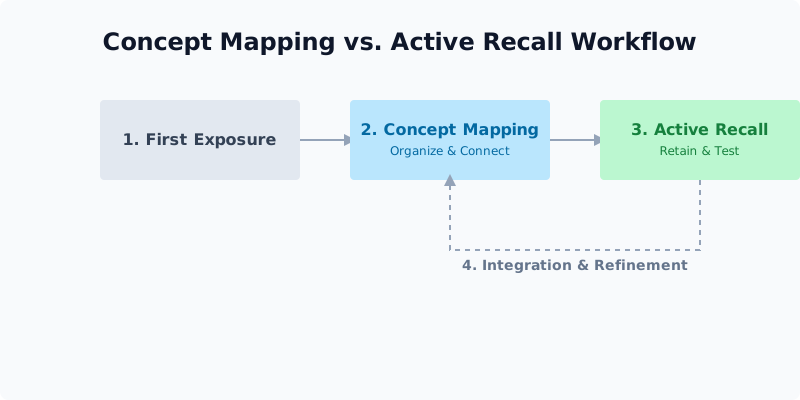
The practical guidance here is simple: you should never choose just one method. They are not mutually exclusive; they are symbiotic. Use concept mapping to organize and connect the complex relationships in microbiology immediately after the lecture, when the material is fresh. Map out the systems and the pathogenesis. Once the map is built and the overall structure is clear, then transition to active recall. Use your flashcards to drill the specific terminology into your long-term memory, ensuring that every fact you memorize has a specific place on your concept map.
How to Succeed: Practical Application
Now that you understand the difference between passive transcription and active concept mapping, here is how to actually apply these frameworks to your daily study routine. Knowing the theory will not save your grade unless you change your behavior.
First, abandon the traditional linear outline format for your notes. I recommend modifying the Cornell Note-Taking Method specifically for pathogens. Draw a line down your page. On the left, write the clinical presentation and the patient symptoms. On the right, draw your concept maps of the pathogenesis, Gram stain, and biochemical tests. This layout trains your eyes to immediately link the clinical sign to the biological cause.
Second, utilize the "Blurting" technique for active recall. After completing a chapter on enteric bacteria, close your book entirely. Take a blank sheet of paper and write down everything you can remember about Salmonella and Shigella. Once you have exhausted your memory, open the book and use a red pen to fill in the gaps. Those red marks are your knowledge deficits. This is highly uncomfortable, but it is scientifically proven to build stronger neural pathways than simply re-reading the text.
When it comes to your actual assignments and case studies, you must apply this structured thinking. If an assignment asks you to diagnose a mock patient, do not just list the bacteria. Explain the immunological mechanism that led to the symptom. You will score significantly higher because you are demonstrating systemic comprehension, not just vocabulary retention.
Finally, employ the "10-Minute Pre-Read" hack. Spend precisely 10 minutes scanning the textbook headings, bolded terms, and summary charts before you step foot in the lecture hall. You are not trying to learn the material; you are priming your brain's architecture to receive it. You will find that the lecture suddenly makes far more sense because you have pre-loaded the terminology.
Common Mistakes to Avoid in Microbiology
Avoiding common mistakes is just as important as implementing the right study strategies. In my experience grading student papers and laboratory reports, the same errors appear semester after semester.
One of the most persistent mistakes is relying solely on rote memorization without building clinical associations. As a student on Reddit recently complained, the sheer volume of memorization feels impossible. It happens because students treat microbiology like a spelling test rather than a biological engine. The only way to avoid this is to physically draw the connections between a bacteria's structure and the disease it causes.
Another major error is falling victim to resource overload. In an age of endless digital information, students often attempt to cross-reference their textbook, three different YouTube channels, and four separate medical blogs for a single topic. This leads to immense confusion and wasted time because every resource emphasizes slightly different details. Pick one primary textbook and one visual aid tool, and ignore the rest.
In the laboratory setting, poor aseptic technique remains the leading cause of failed experiments and lost points. Students rush through the sanitization protocols because they are eager to start the experiment. They forget to flame their loop properly or they leave the agar plate exposed to the air for too long. Not only does this introduce contamination that ruins your data, but it is fundamentally dangerous. Always treat every environmental sample as a potentially pathogenic BSL-2 biohazard.
The common thread among all these mistakes is the "N=1 fallacy." Students find a shortcut that worked for them once, like cramming for a biology 101 quiz, and assume it will work for complex microbiology. It will not. Microbiology requires sustained, integrated effort.
Essential Resources for Microbiology Students
To master this subject, you need the right tools. Here are the essential resources that I consistently recommend to my students.
For high-quality, free textbook alternatives, OpenStax Microbiology is phenomenal. It is peer-reviewed, constantly updated, and completely free. For visual learners, educational YouTube channels like Crash Course or Amoeba Sisters break down complex topics into digestible animations. When you need to dive into academic papers for your case studies, rely on established databases like PubMed or Google Scholar rather than generic web searches.
On a professional level, you should bookmark the American Society for Microbiology (asm.org). They publish exceptional, peer-reviewed clinical case studies that are perfect for practicing your diagnostic reasoning. Reading their "unknown" cases is exactly the kind of active learning that will prepare you for board exams.
If you are still struggling to balance the immense workload of your nursing or pre-med prerequisites, you do not have to do it alone. At takemybiologyclass.us, we provide specialized, expert-level tutoring and class management assistance tailored specifically for demanding STEM courses like microbiology.
Conclusion
You started this article wondering if you had picked the wrong major, staring at a mountain of Latin terms and biochemical pathways. Now, you have a concrete system to dismantle that mountain piece by piece.
Let us review the key takeaways:
- Start with the clinical context: Always link the organism to the patient's symptoms first.
- Group by body system: Organize your notes the way you will see questions on your board exams.
- Visualize pathogenesis: Draw concept maps to understand how a disease progresses, bypassing rote memorization.
- Integrate lab and lecture: Never treat them as separate classes; your lab data proves your lecture theory.
You have got this. Microbiology is incredibly challenging, but it is not impossible. The sheer difficulty of the course is precisely why it is so valuable. According to the U.S. Bureau of Labor Statistics, employment for microbiologists is projected to grow by 4 percent over the next decade, with a median annual wage exceeding $87,000 in 2024. Your hard work now directly translates to a secure, lucrative career.
Here is your next step: Tonight, take a blank sheet of paper and try building your first concept map for Staphylococcus aureus based purely on memory.
If you need personalized guidance to get through your semester, our academic experts are always ready to help you succeed.