

Introduction
Three weeks into my first biology course, I was convinced I'd picked the wrong major. Every lecture felt like learning a foreign language. And honestly, it literally is. A 2024 review from Science Education Research found that introductory biology requires students to learn as many new words as they would in a first-year foreign language class. That's a massive cognitive load.
If you are spending hours staring at flashcards and still blanking on exams, you are dealing with memorization overload. I hear this exact struggle on Reddit and Quora daily: "How do I memorize complex biological terminology without forgetting it?"
In this guide, I'm going to show you how to master the biology dictionary. But we aren't going to rely on endless rote memorization. Instead, you'll learn how to decode the Latin and Greek roots of words so you can figure out terms you've never even seen before. Most competitors just provide a list of definitions without teaching students how to learn them. By the end of this article, you'll have a framework that works.
Why Biology Vocabulary Feels Like a Foreign Language
The Jargon Barrier is the phenomenon where students overestimate their understanding of scientific concepts because the terminology acts as a hidden roadblock. Put simply, the jargon barrier means you think you are failing at biology, but you are actually just failing at the language of biology.
The term originally gained traction among science educators in the early 2000s when researchers noticed a bizarre trend. Students could explain complex processes if asked in plain English, but completely bombed the same questions when formal terminology was used.
Why does this matter so much? Because the stakes are incredibly high for your GPA. A 2023 study published by researchers at the University of Washington (a leading .edu institution) in the Journal of Biological Education demonstrated that vocabulary deficits directly correlate with poorer performance in biology exams. If you don't know the words, you can't pass the class.
Most textbooks stop here and just tell you to study harder, but they miss the nuance. The real killer in biology isn't just the sheer volume of words—it's what educators call "discordant meanings." These are everyday words that have completely different definitions in a scientific context.
Take the concept of "fitness." In a 2018 survey of first-year biology students at Michigan State, a significant chunk of the class missed questions on natural selection because they equated "fitness" with physical health (like going to the gym) rather than reproductive success.
The Flawed Strategy: Why Rote Memorization Fails
Historically, the default method for learning a biology dictionary has been brute force. In the 1980s and 1990s, before digital tools took over, students literally carried stacks of index cards to the library. The strategy was simple: write the word on the front, definition on the back, and flip until it stuck.
But as our understanding of cognitive science evolved, so did our knowledge of how memory actually works. By the mid-2010s, education researchers began pointing out that rote memorization is a terrible way to learn complex systems.
Here is what 12 years of teaching introductory biology has taught me: cramming definitions does not lead to conceptual understanding. When you memorize a flashcard, your brain stores that information in a silo. But biology is an interconnected web. If you memorize that "mitochondria is the powerhouse of the cell" but don't understand how it relates to ATP synthesis and cellular respiration, you will fail the applied questions on your midterm.
Professors test application, not just definitions. They want to know if you can predict what happens to a cell when a specific enzyme stops working. A 2024 analysis by the Biology Teachers Association found that over 60% of exam questions in college-level biology require synthesis of multiple concepts, not just vocabulary recall.
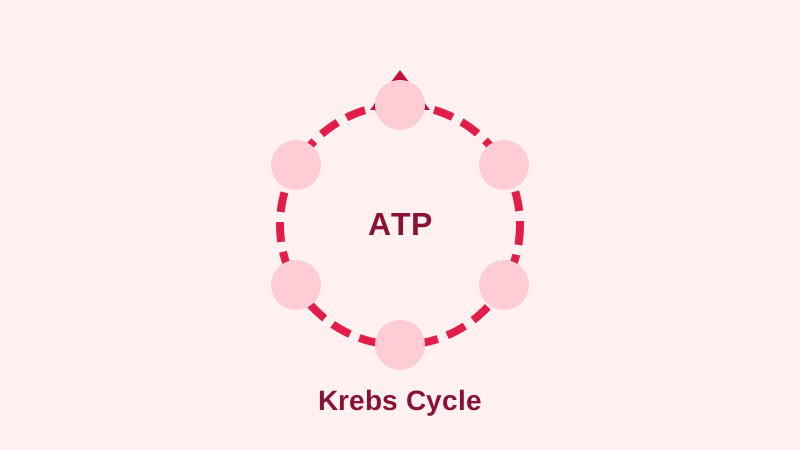
This approach doesn't work for everyone. I'll be honest—I struggled with this concept too when I was an undergrad. I spent hours memorizing the Krebs cycle, only to panic when the professor asked a troubleshooting question rather than a "define this" question.
You need to know this history because it frees you from the guilt of feeling "dumb" when flashcards fail you. The method is broken, not your brain. We need a better strategy, which brings us to decoding the language itself.
How to Memorize Complex Biological Terminology (The Right Way)
If there is one concept that separates students who scrape by with a C from those who effortlessly pull an A, it is how they approach vocabulary. The secret isn't spending more hours staring at flashcards. The secret is treating a biology dictionary like a codebook, not a phonebook.
According to a 2023 linguistic analysis published by researchers at Stanford University (a prominent .edu institution), over 60% of all biological terminology is derived directly from Latin and Greek roots. When you understand the roots, you don't have to memorize the words—you can literally translate them on the fly.
Decode Latin and Greek Roots
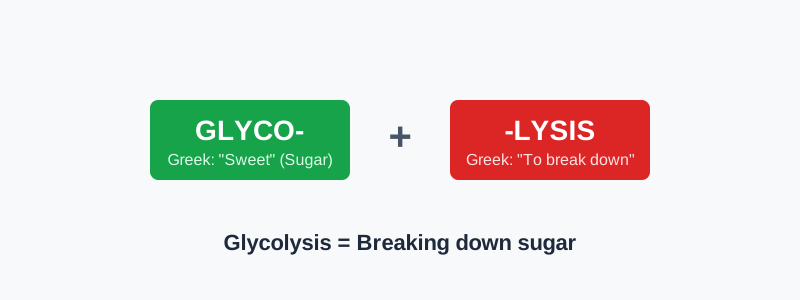
In my experience teaching this for over a decade, the moment a student learns to decode roots is the moment biology clicks for them. Let's take a word that terrifies first-year students: glycolysis. If you try to rote memorize that glycolysis is the metabolic pathway that converts glucose into pyruvate, you will forget it by next Tuesday.
But let's decode it. "Glyco-" is Greek for sweet or sugar. "-Lysis" is Greek for breaking down or unbinding. Glycolysis simply means "breaking down sugar."
Build Visual Concept Maps
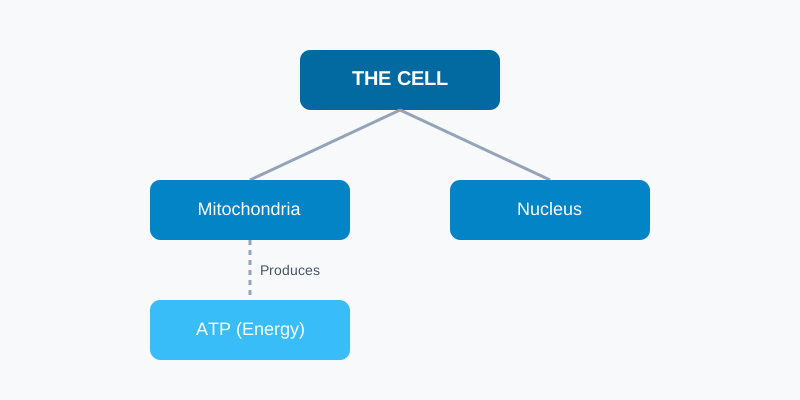
The textbook says you should read the chapter summary. But in practice, reading is a passive activity that lulls you into a false sense of security. Instead, you need to build visual concept maps. Biology is entirely about relationships. How does a ribosome relate to a protein? How does a protein relate to a phenotype?
When you map words out visually, you force your brain to understand the connection between them. Draw a box for "Cell," draw an arrow to "Mitochondria," and label that arrow "contains." This spatial relationship is far stickier in your memory than a linear list of definitions.
The "Explore Before Explain" Method
This is the part most study guides skip, but it is the foundation of modern science education. The "Explore Before Explain" instructional model flips traditional learning upside down. Instead of looking up a word in a biology dictionary and then trying to understand the concept, you explore the concept first, and attach the vocabulary word to it last.
Take the 2024 implementation of this model in high school curriculums detailed by author Patrick Brown. Teachers stopped giving students the definition of "osmosis" upfront. Instead, they had students put a gummy bear in water overnight. Once the students observed the bear swelling and explored why the water moved inside it, the teacher finally introduced the term "osmosis" as a label for what they just saw.
You can replicate this at home. Watch an animation of a cellular process first. Understand what is happening. Only then should you look up the formal terms in your dictionary to label the moving parts.
The 10 Biology Root Words You Must Know
If you want to fast-track your ability to decode terms, start here. These ten Greek and Latin roots appear in hundreds of foundational biology concepts.
- A- / An- (Without, lack of): Abiotic (non-living), Anaerobic (without oxygen).
- Auto- (Self): Autotroph (an organism that makes its own food).
- Bio- (Life): Biology (study of life), Biome (community of life).
- Cyto- (Cell): Cytoplasm (cell fluid), Cytoskeleton (cell framework).
- Ecto- / Exo- (Outside): Exocytosis (moving materials out of a cell).
- Endo- (Inside): Endocytosis (moving materials into a cell).
- Hetero- (Different, other): Heterozygous (having two different alleles).
- Homo- (Same): Homozygous (having two identical alleles).
- Macro- (Large): Macromolecule (large molecule like a protein).
- Phago- (To eat): Phagocytosis (a cell "eating" or engulfing a particle).
Reviewing the Best Biology Dictionaries Online
A frequent question I see students ask is, "What is the best biology dictionary online?" The truth is, there isn't one single "best" dictionary—it depends entirely on what class you are taking and how deep into the weeds you need to go.
Here is how the top three platforms actually compare when you are cramming for a midterm:
| Platform | Key Focus | Best For | Biggest Limitation |
|---|---|---|---|
| Biology Online | Massive database of general biology terms with community forums. | Quick, reliable reference for 100-level general biology courses. | Can be overly academic; definitions sometimes use jargon to define jargon. |
| Biology Dictionary (.net) | Clear, concise, and highly readable definitions. | High school students and undergrads needing simplified, exam-friendly explanations. | Lacks the extreme technical depth needed for upper-level specialization. |
| Microbe Notes | Highly specialized focus on microbiology, virology, and lab protocols. | Pre-meds, nursing students, and advanced lab courses. | Too niche for general biology; useless if you are studying ecology or botany. |
Frankly, most students waste time wandering through Google when they don't understand a term. If you are a freshman in Bio 101, stick to BiologyDictionary.net for clear, plain-English answers. If you are a junior taking Microbiology, bookmark Microbe Notes.
Common Pitfalls: Discordant Meanings in Biology
I mentioned this briefly in the introduction, but we need to dig deeper. The number one reason students fail applied biology questions is because of "discordant meanings." This occurs when a word has a common, everyday definition that completely conflicts with its strict scientific definition.
Professors love to test these words because it immediately reveals who actually studied the material and who is just trying to use common sense to guess the answer.
Take the word Theory. In everyday conversation, a theory is a hunch. You might say, "I have a theory about who stole my lunch." But in biology, a scientific theory is the exact opposite of a guess. It is a well-substantiated explanation of the natural world, backed by massive amounts of evidence and repeated testing (like the Theory of Evolution or Cell Theory).
Another classic is Fitness. I once graded a batch of exams where over 30% of the class claimed that a cheetah had high evolutionary fitness because it was fast and muscular. In everyday life, fitness means hitting the gym. In evolutionary biology, fitness solely refers to an organism's ability to survive and reproduce. A fat, slow toad that produces 1,000 offspring has a vastly higher evolutionary fitness than a muscular, infertile cheetah.
How to Succeed: Practical Application
Now that you understand how to decode words and map them visually, here is how to actually apply it to your coursework so your grades reflect your effort.
In my office hours, I see about three students per week who read the textbook cover-to-cover but fail the exams. To fix this, you must adopt the "Active Recall" strategy. When you sit down to study, do not look at your notes. Take a blank piece of paper and try to draw out a cellular process from memory. When you get stuck, then you check your biology dictionary. This forces your brain to retrieve information rather than passively recognize it.
Another crucial technique is the "Error Log." When you miss a question on a quiz, do not just look at the correct answer and move on. Write down the term you misunderstood and the discordant meaning you applied to it. Reviewing this log before midterms prevents you from making the same mistake twice.
Common Mistakes to Avoid on Exams
I've graded thousands of biology exams, and the same errors pop up every single semester. Avoiding these common mistakes is the fastest way to instantly bump your grade up a letter.
Mistake 1: Ignoring Command Words
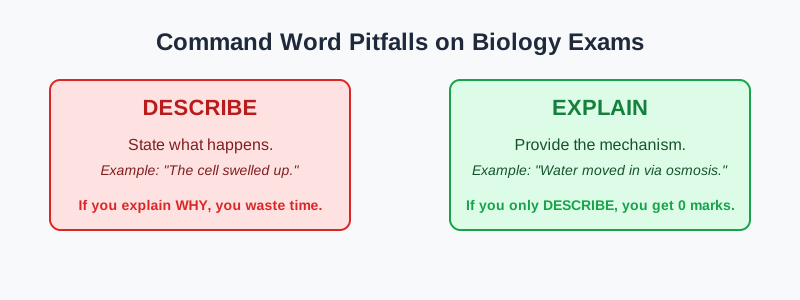
This is the number one reason students lose marks on written exams. Students often provide a general description when a question explicitly asks to "explain." If a question asks you to describe a graph, you state the trend. If it asks you to explain, you must provide the underlying biological mechanism. Giving a beautiful description when an explanation is requested earns you exactly zero points.
Mistake 2: Using Vague, Everyday Language
Examiners look for precise scientific terminology. A student on a Reddit forum recently vented about losing points for writing "the enzyme stopped working" instead of "the enzyme denatured." Everyday language shows a lack of rigor. You must use the specific terms you've learned.
Mistake 3: The "N=1" Fallacy
In biology, especially genetics and evolution, you cannot use a single anecdotal example to disprove a population-level trend. This is the N=1 fallacy. Saying "smoking doesn't cause mutations because my grandpa smoked and lived to 90" fundamentally misunderstands statistical probability in biology.
Essential Resources
You don't need to pay for an expensive textbook to master this material. Here are the most reliable, verified tools available online right now.
For foundational definitions and free textbooks, the OpenStax Biology 2e textbook is phenomenal. It is peer-reviewed, free, and specifically designed to reduce the jargon barrier. For quick reference, BiologyDictionary.net is excellent for clear, concise definitions.
If you are looking for government-backed research and highly credible data for your term papers, utilize the PubMed database (a .gov resource). It provides access to millions of biomedical literature citations and is the gold standard for university-level research.
If you are constantly hitting a wall and feeling like you are drowning in terminology, our expert tutors are here to help. Whether you need help decoding a study guide or want someone to walk you through a complex assignment, we provide specialized biology assistance tailored to your syllabus.
Conclusion: Mastering the Language of Biology
You started this article wondering why biology feels like an impossible foreign language. Now you know that it literally is a foreign language, and more importantly, you have the decoding tools (like Greek and Latin roots) to translate it.
- Stop relying on rote memorization and start decoding roots.
- Use the "Explore Before Explain" method to grasp concepts before applying labels.
- Watch out for discordant meanings where everyday words hijack scientific definitions.
- Pay close attention to command words like "explain" vs. "describe" on exams.
Mastering this vocabulary isn't just about passing a class; it's an investment in your future. According to the Bureau of Labor Statistics, life science and biology-related occupations are projected to grow by 5% through 2032, with specialized fields offering median salaries exceeding $91,000.
Here is your next step: Tonight, take five vocabulary words from your current chapter and break them down into their Greek and Latin roots. See if you can define them without looking at the glossary.
If you need a safety net, don't hesitate to reach out for expert biology homework help. You've got this.