

Introduction
If you're spending 10 to 15 hours per week independently rewriting microbiology notes and still bombing your exams, your study strategy is broken.
I see it every single semester. Students put in massive effort, trying to memorize the dreaded "Bug Parade"—the endless lists of pathogens, virulence factors, and biochemical tests. But passive study methods simply aren't translating to exam performance. As one nursing student recently shared on Reddit, "I get the concepts in lecture, but the lab practicals destroy me." There is a massive disconnect between theoretical understanding and practical application.
This guide will fix that. I'm going to show you a specific, actionable workflow for turning dense lecture slides into high-yield study materials. You will learn how to ditch passive reading, map out complex organisms, and anchor abstract concepts with real clinical cases.
Unlike generic study advice that just tells you to "make flashcards," we'll use active recall frameworks tailored specifically to the unique demands of microbiology.
Why is Microbiology Considered So Difficult?
Microbiology is difficult because it requires students to memorize over 200 distinct microbial species while simultaneously synthesizing complex concepts from biochemistry, genetics, and human physiology. It is not just a vocabulary test; it is a complex systems-level challenge.
Most textbooks get this wrong. They present organisms sequentially, chapter by chapter. But your exams won't test you sequentially. They will test your ability to differentiate organisms based on subtle clinical symptoms or specific lab results. When you study a pathogen in isolation, it feels like random trivia.
The real challenge lies in the cumulative complexity. A 2023 University Curriculum Analysis highlighted that students must navigate a massive volume of specialized, microscopic data. You aren't just learning names; you are learning how a specific biochemical pathway allows a specific organism to evade the human immune system. If you try to rote-memorize this without understanding the underlying mechanisms, you will quickly become overwhelmed.
I'll be honest—I struggled with this concept too when I was an undergrad. I treated the course like an anatomy class, trying to brute-force memorize every detail. It wasn't until I started viewing microbes as functional machines with specific survival goals that the material finally clicked.
A Brief History of the "Bug Parade"
To understand why your microbiology syllabus looks the way it does, you have to understand how the field evolved.
The struggle to comprehend microscopic life isn't new. In 1673, Antonie van Leeuwenhoek, using a simple microscope, became the first person to properly document bacteria, which he called "animalcules." For nearly two centuries, the field remained largely observational. Scientists knew these organisms existed, but they didn't know what they did.
That changed during the late 19th century—the Golden Age of Microbiology. In 1861, Louis Pasteur definitively disproved the theory of spontaneous generation, proving that microbes caused fermentation and spoilage. Shortly after, Robert Koch developed "Koch's Postulates," proving that specific bacteria cause specific diseases. To identify these bacteria, Hans Christian Gram developed the Gram stain in 1884. This simple staining technique fundamentally classified bacteria into two massive categories (Gram-positive and Gram-negative) and is still the cornerstone of every microbiology lab today.
Today, microbiology has shifted heavily toward molecular genetics and biotechnology. Modern labs often rely on DNA sequence-based analysis, like 16S rRNA sequencing, rather than waiting days for a culture to grow. And yet, undergraduate education still requires you to master those foundational 19th-century techniques alongside modern genetic pathways.
Understanding this history helps explain why the course feels so disjointed. You are essentially learning 300 years of rapid scientific discovery crammed into a single 14-week semester. When you recognize that the Gram stain isn't just a random lab protocol, but a historical breakthrough that revolutionized medicine, it anchors the abstract concept to a real event, making it much easier to remember.
How to Study Microbiology Notes (Quick Summary)
If you're short on time, here is the exact 4-step framework I teach my students to conquer the class:
- The 'Note Massage': Reorganize and summarize your lecture slides within 24 hours to move facts into long-term memory.
- Active Recall over Passive Reading: Use the Feynman Technique and spaced repetition instead of blindly rereading textbook chapters.
- Map the 'Bug Parade': Build visual Organism Profiles and flowcharts to classify and differentiate similar pathogens.
- Anchor with Clinical Cases: Connect abstract lab results to real patient symptoms to make the data stick.
Now, let's break down exactly how to execute each step.
Step 1: The 'Note Massage' Technique (Within 24 Hours)
If there's one habit that separates 'A' students from those who fail, it is what happens immediately after the lecture. Most students wait until the weekend to look at their notes. That is a massive mistake. According to academic support data from Rhodes College (rhodes.edu), fleshing out lecture notes within a 24-48 hour window significantly improves exam recall by interrupting the brain's forgetting curve.
Stop Rewriting Your Slides
Verbatim rewriting is a waste of your time. Instead, you need to "massage" your notes. This means taking the raw data from the professor's slides and translating it into a functional study format.
For example, if your professor's slide simply lists "Staphylococcus aureus: Gram-positive cocci in clusters, coagulase positive, causes abscesses," do not just copy that bullet point. Massage it by adding the why. Write down: "S. aureus forms abscesses because the coagulase enzyme creates a fibrin clot that walls off the bacteria from our immune system." Connecting the lab test (coagulase) to the clinical symptom (abscess) builds a durable memory.
To do this effectively, I recommend the 3-Column Method for your notes. Column 1: The Concept (e.g., Coagulase). Column 2: My Words (It clots blood). Column 3: Clinical Relevance (It helps bacteria hide in abscesses).
Step 2: Ditch Passive Reading for Active Recall
You can read the chapter on viral replication five times, and you still might fail the short-answer question on the exam. Why? Because rereading creates what Johns Hopkins University (jhu.edu) researchers call the "Illusion of Knowledge." The material feels familiar when you look at it, but you haven't actually encoded it for retrieval.
The data on this is undeniable. A landmark 2024 meta-analysis led by Freeman et al. at the University of Washington found that active learning increases examination performance by half a letter grade and reduces failure rates by 55% in undergraduate STEM courses.
Enter the Feynman Technique
Instead of reading, you must test yourself. The Feynman Technique is perfect for biology. Here is how you use it: close your book, stand in front of an empty room, and try to explain the entire lytic cycle of a bacteriophage out loud as if you were teaching a high school freshman.
The moment you stumble and say, "And then the virus... uh... does something with the DNA," you have instantly identified a knowledge gap. Go back to your notes, fix that specific gap, and try again.
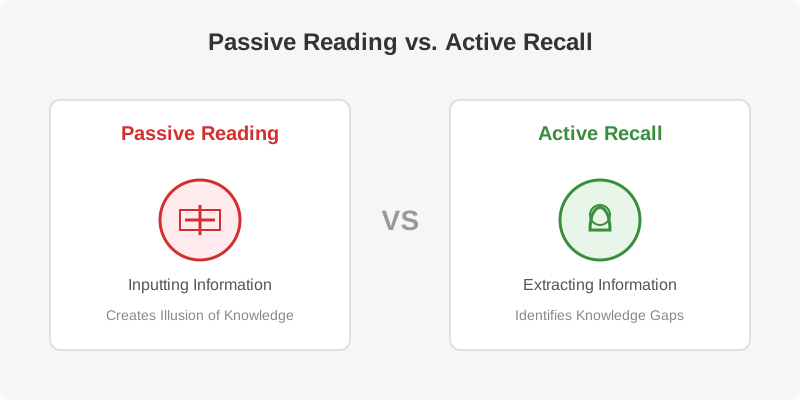
Comparison: Passive vs. Active Study Methods
| Aspect | Passive Reading | Active Recall (Feynman/Testing) |
|---|---|---|
| Key Focus | Inputting information visually. | Extracting information from memory. |
| Retention (1 week) | ~34% retention. | Up to 80% retention. |
| Illusion of Knowledge | High. Material feels "familiar." | Low. Exposes exactly what you don't know. |
| Best Used For | Initial exposure before lecture. | Primary study method for exam prep. |
Step 3: Map the 'Bug Parade' (Visual Organization)
Around midterms, you will hit what students affectionately call the "Bug Parade." This is the point where the syllabus shifts from general concepts to a relentless march of specific pathogens. The sheer volume of bacteria, fungi, and parasites is paralyzing.
One of the most frequent questions I see on Quora is, "What is the best way to memorize microbiology?" The answer isn't "better flashcards." The answer is visual classification. You must build a map.
Building Organism Profiles
Instead of trying to memorize bugs alphabetically, create standardized "Organism Profiles." For every pathogen, document the exact same five data points in the exact same order on a single page:
- Morphology & Gram Stain: (e.g., Gram-negative bacillus)
- Key Biochemical Tests: (e.g., Oxidase positive, Lactose non-fermenter)
- Virulence Factors: (e.g., Exotoxin A)
- Clinical Presentation: (e.g., Burn wound infections, green pus)
- Treatment: (e.g., Anti-pseudomonal penicillins)
If you build this profile for Pseudomonas aeruginosa, you can easily compare it side-by-side with Escherichia coli. Furthermore, I highly recommend buying a massive whiteboard. Draw out the dichotomous keys you use in lab (e.g., the massive decision tree for Gram-positive cocci testing for Catalase, then Coagulase). Mapping the relationships visually prevents you from confusing similar-sounding bugs.
Step 4: Anchor with Clinical Case Studies
Abstract facts are notoriously difficult for the human brain to retain. We are wired to remember stories. If you want to remember that Vibrio cholerae causes massive fluid loss via a toxin that elevates cAMP, anchor it to a story.
A 2024 study in the Journal of Microbiology & Biology Education demonstrated that students using problem-based learning (PBL) and case studies score significantly higher on critical thinking assessments. Prestigious institutions like Duke University Medical School (duke.edu) rely heavily on case-based learning for this exact reason.
How to Use Cases for Studying
Take a real-world example, such as the documented outbreak of ceftriaxone-resistant Salmonella Typhi in Hyderabad, Pakistan. Instead of just memorizing the antibiotic resistance mechanisms of Salmonella, read the case study. Look at the patient presentation (prolonged fever, rose spots). Look at how the epidemiologists tracked the outbreak.
When you connect the abstract biochemistry of a plasmid-mediated resistance gene to the real-world story of a doctor struggling to treat a sick patient, the information suddenly matters. It sticks.
How to Succeed: Practical Application
Now that you understand the active recall framework, here is how to actually apply it to your daily routine.
Study Strategies: The Cornell Method
Use the Cornell Note-Taking Method during lectures. Keep the main column for the professor's notes, but use the left column strictly for questions (e.g., "How does a capsule prevent phagocytosis?"). Use the bottom section to summarize the lecture in three sentences. This forces you to process the information, not just transcribe it.
Assignment Application
When writing lab reports, pay extreme attention to formatting and scientific terminology. Do not mix up "media" and "medium." Always italicize scientific names properly (e.g., Staphylococcus aureus). The professor grading your work will deduct points for these minor errors because they show a lack of attention to detail.
Time-Saving Hacks
Never read the textbook chapter straight through. Read the chapter summary first, look at the bolded terms, and review the end-of-chapter questions before you read the main text. This primes your brain to look for specific answers, drastically cutting down your reading time.
Common Microbiology Study Pitfalls (and How to Avoid Them)
Even with a perfect study system in place, students trip up on highly predictable hurdles. Here are the most common ways students self-sabotage in microbiology, and exactly how you can avoid them.
1. The Gram Staining Disaster
What students do wrong: Leaving the
decolorizer on for too long (making Gram-positive cells appear
negative) or not long enough (making Gram-negative cells
appear positive).
Why it happens:
Rushing through the lab protocol.
How to avoid it:
Always use a control slide and focus strictly on the timing.
Aseptic technique and proper staining are fundamental—if you
mess this up, you'll fail the lab practical, regardless of
your lecture grade.
2. Studying in Isolation
What students do wrong: Trying to memorize
everything alone in their dorm room.
Why it happens:
Feeling overwhelmed and assuming group study will be
distracting.
How to avoid it:
Microbiology is a language. You cannot learn a language
without speaking it. Join a study group where you are forced
to debate the difference between antigenic drift and antigenic
shift out loud.
3. Ignoring the 'Why' Behind Lab Protocols
What students do wrong: Memorizing that
"MacConkey agar turns pink" without understanding why.
Why it happens: It's faster to memorize
the color than the biochemistry.
How to avoid it:
Always connect the color change to the metabolic process
(e.g., lactose fermentation producing acid). If you don't know
the why, a slightly differently worded exam question will
trick you.
Essential Resources for Microbiology Students
You do not have to tackle this material alone. Here are the best resources I recommend to my students.
Free Resources
If your textbook is too dense, switch to OpenStax Microbiology, a fantastic, free, peer-reviewed textbook. For visual learners, channels like Amoeba Sisters and Crash Course Biology on YouTube are excellent for breaking down the foundational concepts before you dive into the dense lectures.
Professional Resources
The American Society for Microbiology (ASM) is the gold standard for accurate, up-to-date information. Their educational resources and clinical case studies are invaluable for understanding how these bugs operate in the real world.
Our Services
If you're still drowning in assignments or struggling to keep your grade afloat, you don't have to fail. Reach out to our expert biology tutors for personalized, step-by-step guidance tailored to your specific syllabus.
Conclusion
You started this article spending 15 hours a week rewriting notes and feeling like you were getting nowhere. Now you have a proven system to take control of your study schedule.
Here is a summary of what you need to do:
- Massage your notes within 24 hours of lecture.
- Use active recall and the Feynman Technique instead of passive reading.
- Build visual Organism Profiles to master the Bug Parade.
- Anchor abstract facts to clinical case studies.
- Never memorize a lab protocol without understanding the underlying biochemistry.
This effort is worth it. According to the Bureau of Labor Statistics (bls.gov), the median annual wage for microbiologists is over $87,000, with stable growth projected through the next decade. The field is expanding rapidly into synthetic biology and the microbiome.
You've got this. The material isn't impossible; it just requires a better strategy.
Here's your next step: Tonight, take your most recent lecture slide deck, pick one pathogen, and build your first Organism Profile. Stop reading, and start mapping.