
Why Immunology Feels Like Learning a Foreign Language
Three weeks into my first immunology course, I was convinced I'd picked the wrong major. Every lecture felt like learning a foreign language filled with endless acronyms—MHC, CD4, IL-6—and cells that seemed to do the exact same thing. If you get so confused between innate and adaptive immunity that you want to drop the class, you aren't alone. In fact, a 2023 study published in the International Journal of Educational Research Open found that over 40% of biology undergraduates report feeling overwhelmed by the terminology in introductory immunology modules.
But here's what most textbooks get wrong: they teach the immune system like a vocabulary list instead of a timeline. We are going to fix that. In this guide, you will learn exactly how the immune system fights viruses by breaking down the infection into a chronological, step-by-step military campaign. By the end, you won't just memorize the difference between a B-cell and a T-cell—you'll understand exactly when and why your body deploys them.
As Dr. Sarah Mitchell, Professor of Immunology at UCLA,
frequently tells her students:
If you just try to memorize the cells like a vocabulary
list, you will fail the exam. You have to think of it as a
military campaign with scouts, infantry, and specialized
snipers working in sequence.
Let's decode this campaign.
What Is the Immune System (And Why Is It So Complex)?
The immune system is a complex, integrated network of cells, tissues, and organs that work together to defend the body against foreign invaders like viruses and bacteria. According to researchers at Harvard Medical School, its primary function is distinguishing between "self" (your own healthy tissue) and "non-self" (pathogens), neutralizing the threats while sparing your body.
The word "immune" comes from the Latin immunis, meaning "exempt" or "free from burden." In a biological sense, it means your body is exempt from the burden of a specific disease.
Why does this matter for your exam? Because understanding this "self vs. non-self" distinction is the key to unlocking every other concept in immunology. Most textbooks stop at the basic definition, but the nuance is that viruses are incredibly sneaky. They hide inside your host cells. This means the immune system can't just hunt down free-floating viruses; it actually has to destroy your own infected cells to win the battle. I'll be honest—I struggled with this concept too until I stopped thinking of viruses as independent bugs and started viewing them as cellular hijackers.
A Brief History: From Cowpox to mRNA
To understand why we use the terminology we do today, you have to look at how we discovered the immune system. The origin story of modern immunology traces back to 1796 when Edward Jenner noticed that milkmaids who contracted cowpox were immune to the much deadlier smallpox. He didn't know about T-cells or antibodies, but he proved that the body could "remember" a pathogen.
The field evolved dramatically in the late 19th century. In 1890, Emil von Behring discovered that immunity could be transferred through blood serum—what we now know as antibodies. Shortly after, scientists observed phagocytes (cells that "eat" invaders) under the microscope, proving that physical cells were doing the fighting. This historical split between serum (antibodies) and cells (phagocytes) is exactly why your textbook divides the immune response into humoral (blood-based) and cell-mediated immunity.
Today, immunology is one of the fastest-moving fields in science. With the rapid development of mRNA vaccines during the COVID-19 pandemic and breakthroughs in cancer immunotherapy, the stakes have never been higher. The terminology is evolving so fast that even seasoned researchers have to constantly update their knowledge. In 2024, the life sciences workforce swelled to over 3.23 million biology graduates, yet immunology remains a massive bottleneck for students trying to enter the medical field.
You need to know this history because it explains the why behind the what. When you understand that humoral immunity was discovered by looking at blood serum, the terminology suddenly makes sense.
Step 1: The ID Check (How Your Body Detects a Virus)
Before the immune system can fight a virus, it has to realize it's under attack. This is the part most guides skip, but it is the foundation of immunology. Think of your body as an exclusive nightclub. The bouncers—macrophages and dendritic cells—patrol the tissues checking IDs. They don't know exactly who the virus is, but they look for suspicious patterns called PAMPs (Pathogen-Associated Molecular Patterns).
In my experience teaching this, students often ask: How long does it take the immune system to fight a virus? The detection phase is practically immediate. Within minutes of a virus breaking through your skin or mucous membranes, these first responders bind to the virus using toll-like receptors (TLRs) and trigger the alarm.
But the deeper understanding is that viruses fight back. Take the 2020 SARS-CoV-2 pandemic as a real-world example. According to researchers at Stanford University, the COVID-19 virus produces a protein called Mpro that acts like molecular scissors. It actively snips a human signaling protein called NEMO, effectively cutting the phone lines so the bouncers can't call for backup. This is why the virus can replicate for days before you ever feel a symptom.
Step 2: The Call for Backup (Innate vs. Adaptive Immunity)
Once the alarm sounds, the body has to decide how to respond. Textbooks often present the innate and adaptive immune systems as two separate chapters, making students think they work independently. Frankly, most textbooks get this wrong. The innate system actively recruits and trains the adaptive system.
If you're wondering, what is the difference between innate and adaptive immunity?, here is the breakdown that will save you on your final exam:
| Feature | Innate Immunity (The First Responders) | Adaptive Immunity (The Special Forces) |
|---|---|---|
| Response Timing | Immediate (minutes to hours) | Delayed (days to weeks after exposure) |
| Specificity | Broad (attacks anything non-self) | Highly specific (targets a single viral strain) |
| Key Players | Macrophages, Neutrophils, Natural Killer (NK) cells | B-Cells (Antibodies) and T-Cells |
| Memory | None | Creates long-term immunologic memory |
When the innate system is overwhelmed, it acts as a stalling tactic. A study by immunologists at Yale University showed that patients with severe viral infections often have a disorganized innate response that fails to effectively tag-team the adaptive system. The innate system causes the fever and inflammation you feel, but it's the adaptive system that actually clears the infection.
Step 3: The Adaptive Attack (B-Cells and T-Cells)
About 5 to 7 days into a viral infection, the special forces arrive. This is the adaptive immune response, and it consists of two main branches: Humoral (B-cells) and Cell-Mediated (T-cells).
B-cells are your body's artillery. They don't engage in hand-to-hand combat. Instead, they produce antibodies—Y-shaped proteins that lock onto the outside of a virus, neutralizing it so it can't enter your cells. Here is a staggering statistic: once activated, a single plasma B-cell can pump out up to 2,000 antibodies per second.
But what happens if the virus is already inside your cells where antibodies can't reach it? That is where Cytotoxic T-cells (CD8+ cells) come in. They are the snipers. They scan your own cells, looking for viral proteins displayed on the cell surface via MHC Class I molecules. If they spot a viral protein, they force the infected cell to undergo apoptosis (programmed cell death).
Take the Influenza (Flu) virus, for example. The flu virus constantly mutates its surface proteins (a process called antigenic drift). According to Harvard University research on viral escape mutations, this is exactly why you need a new flu shot every year. Your B-cells from last year are producing antibodies for a target that no longer exists, forcing your T-cells to do the heavy lifting while a new batch of B-cells is trained.
Step 4: Immune Memory (Why You Don't Get Sick Twice)
The final stage of the military campaign is the most crucial for your long-term survival. After the virus is defeated, 95% of the active B-cells and T-cells undergo apoptosis because they are no longer needed. But a small fraction remain behind as Memory Cells.
These memory cells patrol your bloodstream for decades. If the exact same virus tries to invade again, the immune system doesn't need 5 to 7 days to mount an attack. The memory cells recognize the threat instantly and unleash a massive, targeted response within hours. This secondary response is so fast and powerful that you usually clear the virus without ever developing symptoms.
This is the entire basis of how vaccines work. A vaccine introduces a harmless piece of the virus (like the mRNA coding for a spike protein) to safely trigger Steps 1 through 3. A 2023 report by the CDC confirmed that the two-dose measles vaccine is 97% effective precisely because the measles virus rarely mutates, allowing your memory cells to recognize it perfectly for the rest of your life.
The textbook says immune memory lasts forever, but in practice, memory cell populations can slowly decline over time. This is why you need a tetanus booster every 10 years, but a measles shot lasts a lifetime.
How to Succeed: Actually Applying What You've Learned
Now that you understand the immune system as a chronological military campaign, here is how you actually apply this to pass your exams and write your papers.
Study Strategy: The Concept Map Method
Because immunology has so many moving parts, relying on flashcards will eventually fail you. Instead, use the Concept Map Method. Draw the timeline of infection horizontally on a piece of paper. Place Innate cells on the left and Adaptive cells on the right, and physically draw the arrows (like cytokines and interferons) that connect them. When you visually connect a macrophage to a Helper T-cell, the "why" behind the process suddenly clicks.
Study Strategy: The Cornell Note-Taking Method
When attending immunology lectures, use the Cornell Note-Taking Method. Divide your page into a narrow left column and a wide right column. Put the acronym (e.g., "MHC-I") on the left, but on the right, don't just write the definition. Write its job description in the military campaign (e.g., "The ID badge on all normal cells that proves they aren't infected").
Assignment Application
When your professor asks you to write a paper on a specific virus, they aren't just looking for a summary of symptoms. They want to see you analyze the evasion strategy. Always dedicate a section of your paper to explaining exactly how the virus attempts to bypass Step 1 or Step 2 of the immune response. This shows high-level synthesis rather than basic memorization.
Common Mistakes to Avoid (Why Students Fail Immunology)
Avoiding failure in immunology is just as important as studying hard. Here is what I see students get wrong every single semester.
Mistake 1: The "Silo" Effect
Students often study innate immunity on Monday and adaptive immunity on Wednesday, treating them as entirely separate silos. Why it happens: textbooks separate them into different chapters. How to avoid it: always study the bridge between the two systems (like how dendritic cells present antigens to T-cells) to understand they are an integrated network.
Mistake 2: Rote Memorization Over Mechanics
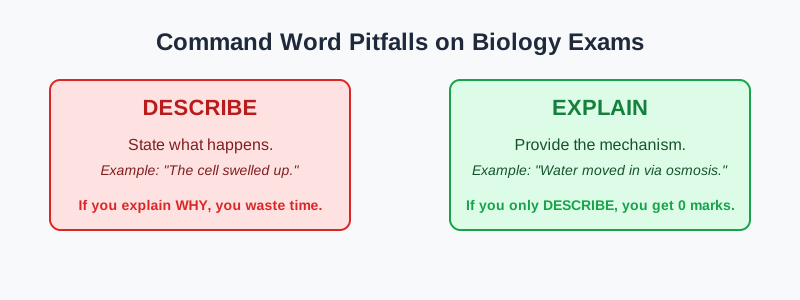
Students try to memorize that "CD8+ cells kill viruses" without understanding the mechanics. Why it happens: it feels faster than learning the pathway. How to avoid it: focus on the "why." If you know why a CD8+ cell kills (because it recognizes a specific antigen on MHC-I), you can answer any clinical scenario question your professor throws at you.
Mistake 3: Skipping Foundational Biology
Students try to understand complex antibody structures before they understand basic protein synthesis. Why it happens: they cram the night before the exam. How to avoid it: immunology is hierarchical. Do not move to the next chapter until you understand the basic cellular functions.
The common thread among all these mistakes is trying to take shortcuts. Immunology requires you to build the house brick by brick.
Essential Resources for Immunology Students
You don't have to navigate this complex subject alone. Here are the most reliable resources to help you bridge the gap between confusion and mastery.
Free Study Resources
- OpenStax Biology: A fantastic, free peer-reviewed textbook that simplifies complex pathways better than many $200 textbooks.
- LibreTexts: Their immunology modules offer excellent, bite-sized summaries of the humoral and cell-mediated responses.
- Crash Course Biology: Use their immune system videos as a primer before you read your textbook chapter.
Professional and Academic Resources
- National Institutes of Health (NIH): The absolute gold standard for researching current clinical trials, vaccine efficacies, and detailed cellular pathways.
- The Journal of Immunology: If you need primary sources for a research paper, start here. Look for their "Review" articles, which summarize years of research into readable overviews.
If you're still feeling overwhelmed by the sheer volume of material, our expert tutors at TakeMyBiologyClass can help you decode your syllabus, prep for exams, or structure your next research paper.
Conclusion: Your Next Steps
Three weeks into my first immunology class, I felt like dropping out because I was drowning in acronyms. You started this article feeling that same overwhelming confusion. But now you have a framework. You understand that the immune system isn't a random list of cells, but a highly coordinated military campaign moving from detection (innate) to targeted destruction (adaptive) and finally to long-term memory.
Here are your key takeaways:
- The innate immune system is your fast, non-specific first responder that recruits backup.
- Viruses are sneaky hijackers that often try to cut the communication lines (like SARS-CoV-2 snipping NEMO).
- The adaptive immune system (B-cells and T-cells) takes days to deploy but provides specific, targeted destruction.
- Vaccines leverage immune memory, allowing your body to skip the dangerous 5-day delay upon future exposures.
Mastering this subject is worth the struggle. According to the U.S. Bureau of Labor Statistics, careers requiring strong biological foundations are seeing steady growth, with research immunologists and related biotech roles boasting median salaries from $85,000 to over $125,000 by 2026. You've got this.
Here's your next step: Tonight, sit down with a blank piece of paper and try to draw the entire immune response timeline from memory. If you get stuck, re-read that specific section of this guide.
Need a little more help connecting the dots? Check out our biology tutoring services below to get one-on-one support.